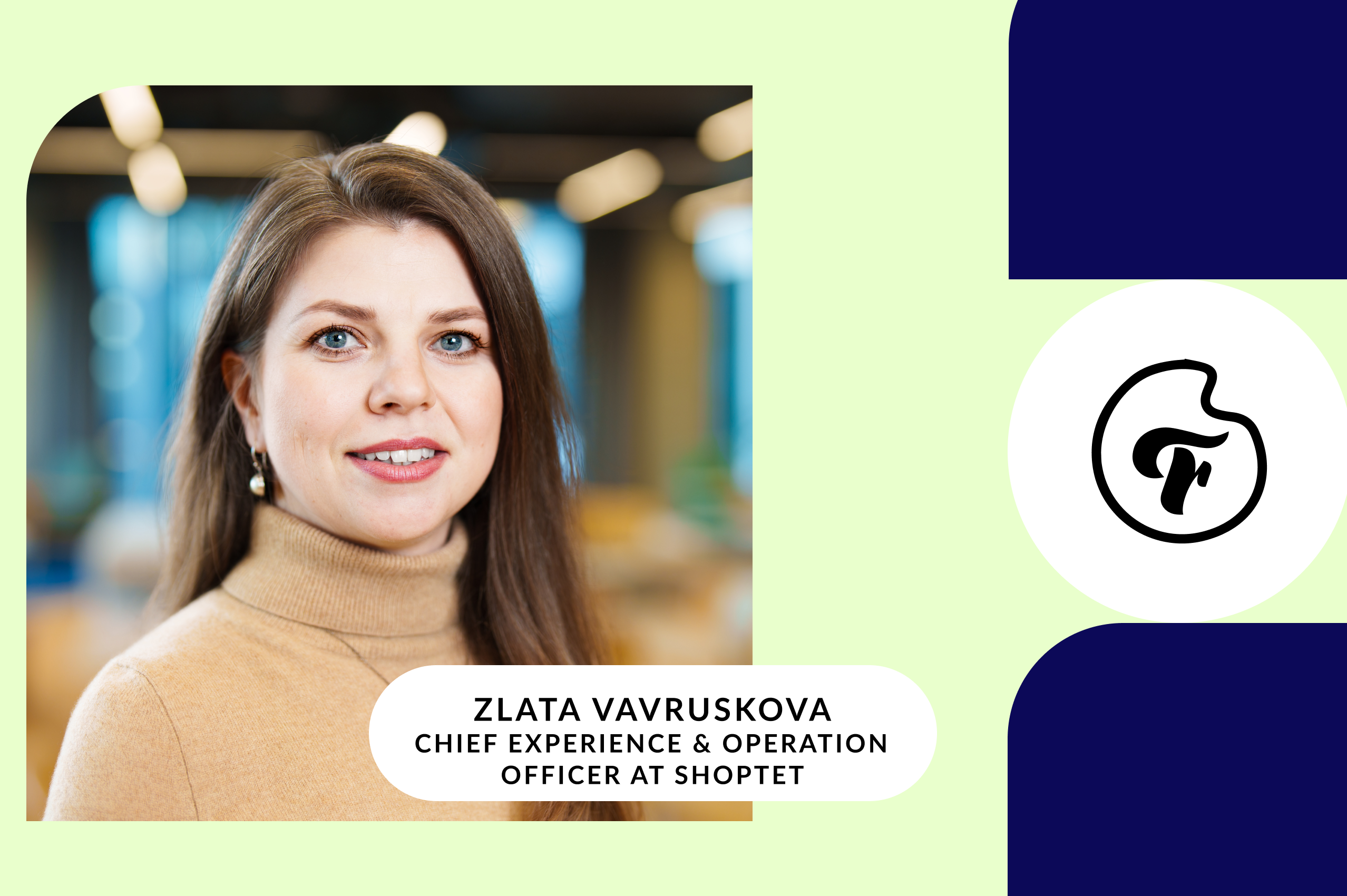
Zlata Vavruskova’s leadership journey started early, shaped by ambition, trial and error, and a deep belief in people. Today, as Chief Experience & Operation Officer at Shoptet, she focuses on building teams that grow, take ownership, and ultimately thrive without constant supervision. In this interview, she reflects on the moments, doubts, and philosophies that defined her approach to leadership, mentoring, and customer experience.
This is really a throwback to the distant past. I was nineteen when I was first “thrown” into the world of leadership. I worked as a successful salesperson at the fashion store Mango and I was very ambitious. The area manager noticed this and offered me the position of a manager of a new store. Little did I know then that this would be the beginning of a long journey, during which I would discover that what I enjoy most is working with people, developing them and creating an environment where customers and teams thrive. It has been going on for 18 years.
Every role, every company, and every person I met influenced me in some way. In my first management role, I wasn’t a good manager. I was nineteen and had people on my team who were a generation older than me. I had no idea how to earn respect, and I mistakenly thought that a manager had to know everything and had to have the final say. I gradually understood that true leadership is about listening, connecting people, and creating value together. A great leader is not someone who stands in the spotlight, but someone who allows others to shine.
I fully realized this when I joined Slevomat in 2019 and met the then COO, Ladislav Veselý. During the interview, he told me: “My goal is to be unnecessary.” This sentence accurately described what I enjoy about leading people. I am happy when I can create an environment in which people grow, teach them, delegate, mentor them, and watch them become independent and confident professionals. And that the entire company grows as a result.
I never had one specific mentor. It was more like moments, meetings, and sentences that get under your skin. For example, the one from Láďa Veselý, or sentences like: “If you can’t, stop.” or “No one can see your work better than you.” Such small but powerful sentences can often change the way you think.
Mentoring, for me, is always a combination of experience and coaching. I don't just give advice, I help others find their own path, and when it makes sense, I add my own perspective. For me, mentoring is about helping others hear their own voice better, not taking over mine.
Around the age of thirty, I had a period of doubt. I tried various jobs: a baker, a postwoman, I even wanted to be a tram driver. I was on a journey to find myself. But in the end, I naturally returned to leading people. That’s when I understood that this was my path. Since then, I have had no doubts.
Less talking, more listening. You don't have to be the best at everything in the world. As a leader, you should adapt to others, not them to you. And don’t be afraid to be expendable - that’s the greatest gift you can give yourself and your team.
A few years ago, I met a former subordinate from my time leading teams at Estée Lauder in the city. She was walking with a stroller and told me that she often thought of me. She said that I was strict but fair, and that I made her understand the importance of knowing why we were doing something and where we were going.
At that moment, I realized that this was exactly what Drew Dudley calls a “lollipop moment.” It’s a moment when your behavior or words affect someone else without you even realizing it. It may be an ordinary day for you, but for the other person, it’s a formative experience.
I consider moments like these to be the greatest gift of leadership. It’s not about how many people you lead, but what kind of impact you make. I hope that the people I’ve had the opportunity to work with have had a few of these small, quiet moments that have helped them grow or realize something. Because that’s what true leadership is all about.