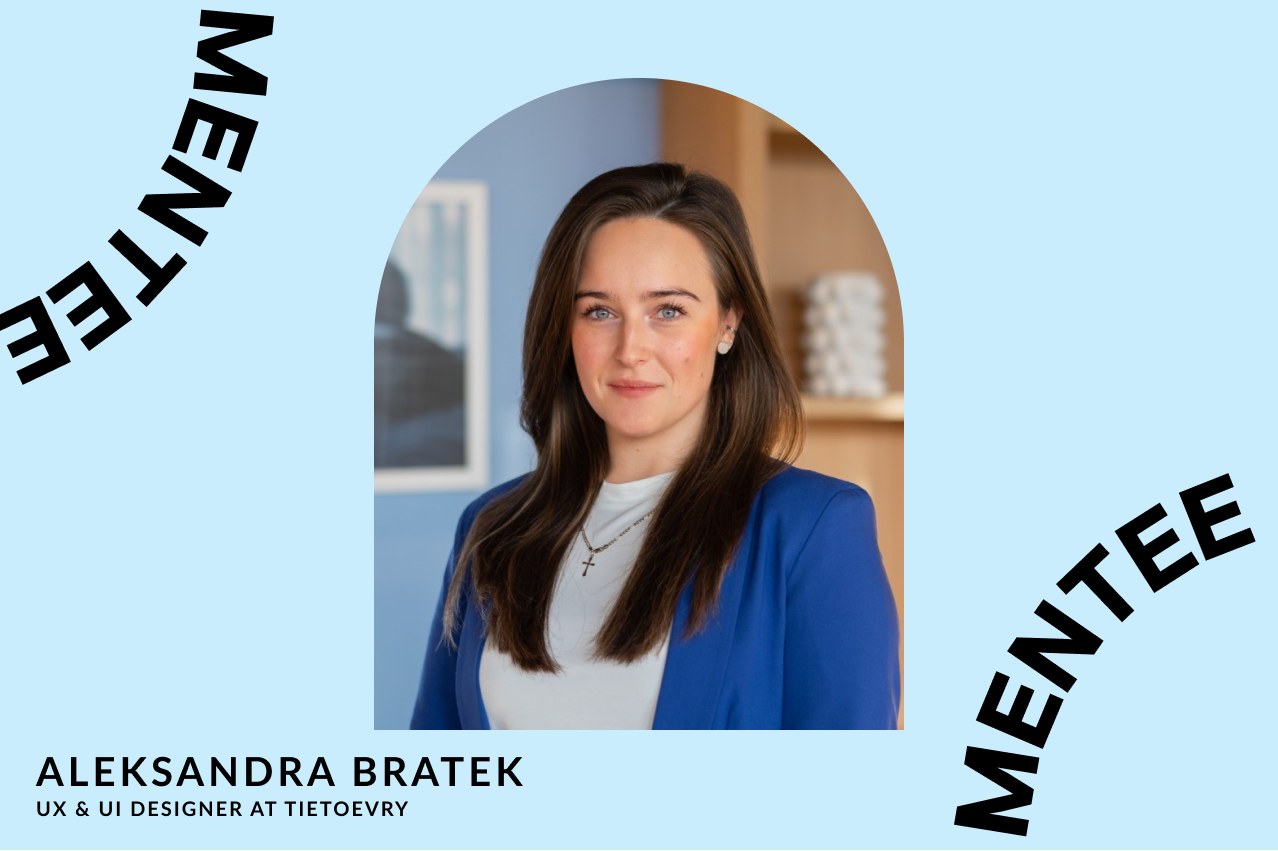
Welcome to our Mentee Spotlight of Femme Palette, where we share inspiring growth journeys from women in our mentoring program. In this interview, we meet Aleksandra Bratek, UX & UI Designer at Tietoevry and a graduate of Interaction Design from the Architecture and Design School in Oslo. Originally from Poland and now based in Norway, Aleksandra joined the Femme Palette mentoring program at a pivotal moment - leading teams as a junior designer while navigating imposter syndrome, rising expectations, and the growing pressure to connect design with business impact. Here, she shares how mentorship helped her build confidence, speak the language of business, and step into her senior potential.
I’m a user experience designer with a master’s degree in Interaction Design from the Architecture and Design School in Oslo. I’m originally from Poland, but I’ve lived in Norway for the last 13 years. I joined the program after two years of working professionally as a UI & UX designer in a large IT company.
During my last years in school, I collaborated with my current company, and they offered me an internship, which later turned into a full-time position after I graduated. After graduating, I jumped directly into a “lead” role, even though I was a junior designer at the time, as I was the only designer on the team working on the product.
It wasn’t easy. As a junior, I didn’t yet have experience with cross-disciplinary collaboration at such a high and demanding level, which a large IT company requires. I had to work fast, think big, and quickly correct my mistakes.
In the meantime, two things happened: the “AI hype” boom, and a shift in the design mindset. All designers, including juniors and interns, were now expected to think like seniors - focusing on metrics, using business language, and connecting design work to the OKRs the company had. It sounds obvious now, but at that time I felt bad because I couldn’t keep up with the speed the position required from me, even though I was eager to learn.
That’s when my manager, who was the Head of Design at the time, stepped in. He saw potential in me and wanted to help accelerate my professional growth. It wasn’t easy - but it was worth it.
I started the program with a few challenges, all of them leading toward the same big goal: stepping into a more senior role. I was already leading teams as a junior designer - not without mistakes, moments of frustration, or the feeling that I wasn’t good enough, which my mentor identified early in the program as imposter syndrome.
I was working with many amazing senior designers who were leading their own teams, and I was truly impressed by how well they handled their work - their designs, their tasks, and especially how confidently they could advocate for design decisions to leadership. I wanted to become one of them. I wanted to think and work as the senior designer I knew I could be.
We worked on several things during the mentorship, but I think the biggest impact was in the area of business design and in learning how to deal with imposter syndrome. We spent a lot of time working with business language - how to present and argue for design findings, how to connect them directly to the company’s OKRs, and how they affect revenue and sales.
My need to understand business decisions gradually turned into a genuine interest. I now enjoy reading about business, how it can grow, and how teams should be led to achieve better results.
The imposter syndrome is not fully gone - and probably never will be - but there is one quote from my mentor that helps me deal with it: “What will be the worst thing if you do?” Our fear often comes from imagined future outcomes which, in most cases, will never happen. This mindset helped me understand that not every decision will make the world fall apart. Have you failed? Don’t worry - let’s fix it instead.
The program helped me understand that I’m not the only one who feels this way, and that many people have been exactly where I am now. It is a natural part of growth, and real growth happens outside of the comfort zone.
I’m more confident now and take more responsibility for my work. I’m also more open and less afraid to say “yes” to things that may not feel completely suitable for my current position. If I want to grow into a senior role, I need to do the things senior designers do daily.
Every lesson was valuable, but there is one that really stayed with me. I asked my mentor about her own experience of failure. She shared a personal story from her early career, when she failed to communicate something important due to a lack of business design language.
As designers, we talk about emotions, user needs, and empathy, while leadership needs to see numbers, results, and possible outcomes. Now I understand that these things are not so far apart - we just need to find a common language.
This story showed me that everyone makes mistakes, and that it is okay to feel bad or embarrassed. The goal is not to let those feelings overwhelm you, but rather to let them drive you toward better outcomes. Situations like this help us grow - especially the uncomfortable ones.
When you have such an open and willing-to-teach mentor, as I did, you start to notice that in many situations where you previously felt scared or unsure, you now have your own thoughts or can relate to the discussion or an anecdote. It simply becomes less overwhelming and easier to deal with.
I’m still growing into a senior position, but this mentorship helped me understand and organize my journey and how I want to get there. The program encouraged me to become more proactive, take initiative, and evolve as a colleague, a team player, a senior designer, and simply as a better person.
If Aleksandra's story resonates with you, maybe it is time to write your own. Whether you are navigating a career transition, looking to step into your next level, or simply ready for that external perspective that changes everything, our mentoring program is here for you.
Your story could be the next one we tell. Explore the Femme Palette mentoring program and take the first step today.